
Shops where precision
isn't optional.
We work with job shops, precision machining operations, and manufacturers across aerospace, medical, and general industrial markets. If you hold tight tolerances, quote complex work, or need equipment that fits the actual parts you make, this is where we start.
What metalworking shops
are working through.
These are the conversations that happen before the first machine quote. They're about what the current equipment can't do, and what the next investment needs to get right.
The risks worth thinking through
before you commit.
A capital investment in machining equipment is a long commitment. Getting the fit right upfront is what keeps these from becoming production realities.
We look at the work
before we talk equipment.
We start with the parts. The materials, tolerances, volumes, and growth plans all get reviewed before a single machine is on the table. That means the recommendation you get is built around the actual production reality, not the nearest spec match.
We have manufacturer relationships that come with real service backing, and we stay involved through installation, training, and the early production ramp, because that's when fit actually gets proven.
"A major capital investment deserves clarity, not a quote and a handoff." Bill Koster
-
01Application ReviewParts, materials, tolerances, volumes, and growth plans. All reviewed before any equipment recommendation is made.
-
02Honest GuidanceWhat's actually needed, not what's available in inventory or easiest to sell. Fit-first means the recommendation has to make sense for your shop.
-
03Manufacturer Relationships That Hold UpWe represent manufacturers we can stand behind, with service support that stays engaged after the machine ships.
-
04Training & Continuity After the SaleWe stay involved through startup and early production, because the transition from installation to running parts is where most issues surface.
-
05A Partner Who Understands the WorkNot a drop-off sale. We know the production reality because we've been in it, and we stay available when questions come up.
What we work with in metalworking.
A working summary of the equipment categories we represent and support, matched to the application, not listed for its own sake.
- CNC Lathes & Turning Centers
- Vertical Turning Lathes
- Horizontal Lathes
- Vertical Machining Centers (VMCs)
- Horizontal Machining Centers (HMCs)
- Gantry Machines & Bridge Mills
- Horizontal Boring Mills
- Vertical Boring Mills
- Wire EDM
- Sinker EDM
- Grinding Systems
- Robotic Machine Tending
- Pallet Systems
- Loading & Unloading Automation
- Mist Collection
- Fume & Smoke Extraction
- Industrial Air Filtration
Don't see what you need? We work across manufacturers and have access to quality used equipment. Let's Talk →
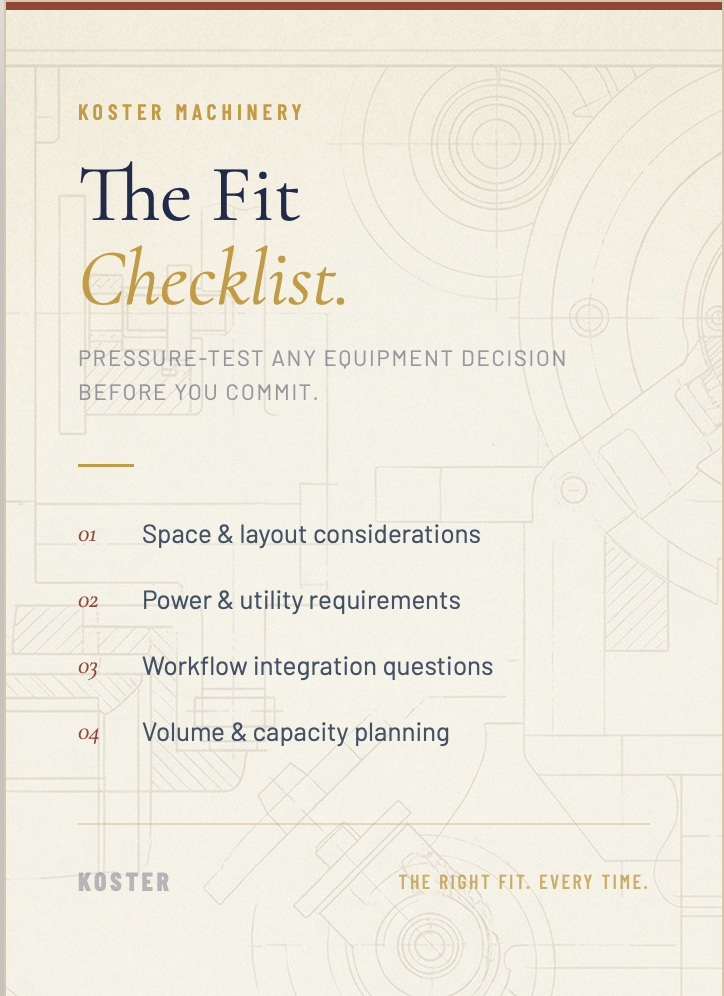
Download the
Fit Checklist.
Before you commit, make sure you've covered the questions that matter. This checklist walks you through exactly what we review before recommending anything.
- Space & layout considerations
- Power & utility requirements
- Workflow integration questions
- Volume & capacity planning
No spam. Just the checklist.
Brands chosen for a reason.
Not a catalog. Each manufacturer was selected because their equipment holds up in real production environments, and because Bill knows their lines cold. Click any logo to hear his take. Partners marked Exclusive are sold directly through us.
 Bill's Take →
 Bill's Take →
 Bill's Take →
 Bill's Take →
 Bill's Take →
 Bill's Take →
 Bill's Take →
 Bill's Take →
 Bill's Take →
 Bill's Take →
 Bill's Take →
 Bill's Take →
A real decision, not a hypothetical.
This is the kind of situation we work through regularly. The process and the outcome are what we show up to deliver every time.
A precision machining shop producing components for an aerospace supplier was seeing tolerance failures on a family of high-value parts. Their current VMC had been reliable for years, but tighter customer specs and higher volumes had pushed it past its reliable capability. They were managing it with rework, but that margin was gone.
We started with the parts. Material, tolerances, volumes, and the work they needed to quote next. That review shaped the machine criteria: work envelope, spindle performance, thermal stability, and controls the team could realistically run. We matched those requirements to the right manufacturer, coordinated the evaluation, and stayed through installation and first-article qualification.
First-article qualification passed clean. The shop is running the parts to spec, has taken on additional work from the same customer, and has a machine that fits the work they're winning, not just the work they had.
Other manufacturing sectors we serve.
Start with a conversation.
Not a quote.
Tell us about the parts you make, the tolerances you hold, and where you want to take the work next. We'll ask the right questions and figure out what actually fits. No pressure, no pitch, no agenda other than fit.
Talk to someone now. No queue, no gatekeeping.